The title of this blog is taken from my favorite movie: The Princess Bride. Miracle Max and his wife say "Have fun storming the castle!" as Inigo, Fezzik, and Westley set off on their big adventure to save the princess. And that's what this blog is about: adventure, fun, and saving the world.

Wednesday, September 22, 2010

Back to School!

The Negril Rotary Club donated tents for shade
and tables and chairs for seating.


A LOT has happened in the past three months and the St. Anthony soup kitchen looks very different today than it did in June. The most noticeable difference is the lack of children: almost all the children are attending school now!

During the past months of my service I met with as many organizations and people in Negril as I could: especially the service organizations. At the meetings I would explain who I am, what organizations I've been working with, and ask them to do the same. Invariably, the soup kitchen got a lot of attention. "What do you mean the children are NOT GOING to school?" All it took was mentioning the kitchen to the community and they were on board. What do you need? How can we help? How can we work together to get these children back into schol? NEET dropped off math and science text books, workbooks, and reading books the next day. The Negril Rotary Club donated tents, tables, and chairs so that the children would not have to fight over the limited chairs and space in the shade. A community artist gave a lesson in drawing. Even a tourist couple from Tennesse read about the soup kitchen online and brought down more school supplies that we ever dreamed we would have. Jeanne Fisher and Joan Cooney (rotarians and community members) started coming weekly to teach the children. Jeanne had taught for many years in Montego Bay and delivered excellent lessons in literacy, numeracy, and of course manners. The soup kitchen had transformed into the NYAM center (Negril Youth Activities and Mentoring center).

The final step is reaching the teenage boys who give tourists horse
rides on the beach instead of attending high school.

Throughout the summer we harped on the importance of going to school. Why don't you go? I don't have the shoes miss. No uniform miss. No birth papers miss. Community members have donated shoes, clothing, and old school uniforms. Joan Cooney even paid the fee for birth papers for one of the children: an eleven year old girl who doesn't know how to begin to form the letters to write her name because she has never been to school. She went to school for the first time on Monday complete with shoes and a uniform.

Sandy and I work with the students while Brother Tom looks on.

Thursday, July 1, 2010

NYAM: The Soup Kitchen Children


I'm on my way to the soup kitchen, still about 20 yards away when I hear it "Teacher!" I look up to see about 20 smiling faces bobbing towards me. Shrieks of joy and I'm surrounded in a giant bear hug. Arms at all heights are grabbing my things. Let me tek yuh books, yuh bags, yuh bokkle. My heart melts as I smile back. Today is going to be tough.


A what dis word b-e-a-k? Sound it out. What sound does B make? Whoa, watch the shirt as a sticky three year old pulls his way up into my arms. Miss, miss! Look miss! Cyar, cat, rat, hat. I can get a sticker now miss? Whoops dodge the soccer ball flying at my head. Miss, I cyan ave a likke ice water? Styrofoam cup pieces fly from Kashwayne's mouth onto little Ricardo, the same three year old who was trying to scale my leg earlier. Here it comes: smack, smack. Blows fly back and forth. Theresa of course steps in to defend her brother and now three arms are flying. Some beaks are small. Some beaks are for p-p- Do you remember what we said about hitting? Use your words!
They love showing off for the camera.

This is the parking lot of the the local soup kitchen. The children...well my neighbor Ms. Beulah calls them "street children." Sandy (a fellow PCV) and I call them the soup kitchen children. They aren't in school because they can't afford it. (School is free in Jamaica but you have to have shoes, a uniform, lunch money, taxi money...) Many of them come from troubled homes. There are more of them every day. They range from ages 2 to 16 and are at all different levels. They are the most challenging and most rewarding part of my day.

What am I doing there? Well, it started with Sandy and I trying to fill in for some of what they are missing by not going to school. We play math games, read stories, talk about science, make maps, and study calendars. We've also started treating some cuts and scrapes and Sandy even started treating their animals too! The children have been very responsive, asking for "school" on the days that the soup kitchen isn't open.

First it was just the young children, then the teenagers started coming.
Now, the puppies come too!

From surveying the community we realize that the ultimate goal of this project is to get the children back into school and we are simply filling a temporary gap and serving as mentors. In fact, that's what Sandy has named it: the Negril Youth Activities and Mentoring Center, or the NYAM center. Nyam is patois for eat, similar to the english expression "chow down."

A cross country team's service trip had a positive impact through playing soccer.

I think about the students all the time, and have great dreams for the NYAM center. The vision is to introduce the students to community members (some of whom have already expressed interest) and facilities (we have trips to the fire department and health center lined up) so that they have positive role models in their life and that they can learn to take care of themselves using their community resources. A cross country team from the states came for a service trip. They had a really positive impact playing soccer with them, so a sports league might be a key element of the center as well. People are noticing the work that we do at the soup kitchen. I'm starting to get called "teach" on the streets even though most of my days are spent doing environmental work. When I was first assigned to Negril, Jamaica with the Peace Corps I was afraid there wouldn't be need. I'm realizing how unfounded my fears were. I'm happy to have found the soup kitchen children. Some mornings I'm tempted to yell "Students!" and run to them before they can get to me.

Lunch time!
Sandy helps the children arrange themselves for lunch
while Ms. Velma, one of the "soup kitchen ladies" looks on.

Friday, June 25, 2010

Dem Catch Dudus!

The police captured Dudus on Wednesday. He waived his rights to trial in Jamaican court and is now in the US. He probably did this in order to get out of Jamaica as soon as possible. His father died in a Jamaican prison, killed by co-conspirators who didn't want their identity unveiled. The arrest came as a surprise to everyone. It was non-violent and everything in Kingston has remained relatively calm since then.

Comic by Clovis from the Jamaica Observer

However, the real story was revealed by the the cartoon and comments which accompanied the article in the observer. Dudas was wearing a wig to disguise himself as a woman! I was really surprised to see the wig because most Jamaicans are very homophobic. Male friends don't usually touch one another. It is a big insult to say a man moves like a "fish" or is "chi chi" or a "batty man." Apparently he is not the first Jamaican cross-dressing gangster either. As one of the commenters on the Observer article said "I guess when trouble tek yuh, pickney shut do affi fit yuh." (Literally: When trouble takes you a child's shirt will have to fit you.)

An extreme example of anti-homosexual sentiment. I took this picture in a local taxi. A lot of Jamaicans will write things on their cars in white letters (usually on the outside). Bunn is Patois for burn and sadamite is gay person (from sodomy)

Sunday, June 20, 2010

Land Crabbing

The biggest land crab awaits his fate in my bathtub

I have many fond memories crab memories from the jersy shore (as we Philadelphians would say "Down the shore"): cleaning crabs with my grandmother, being yelled at by my Italian great-grandfather Pop-pop "Don't touch-a my crab-a traps!", and sitting with my family picking through crab after crab as the sunset over the bay and the atlantic city skyline lit up the night sky.

On Friday night while leaving a reggae concert on beach road, I saw "wan 'ole 'eap a crab" scurrying up and down the shoulder. These aren't Maryland Blue crabs; they're LAND CRABS. With reggae beats still in my head I started planning an epic hunt. I started asking around about these dinosaurs, finding out everything I needed to know and gaining the advantage on my opponent. You don't catch these crabs with traps because they don't live in the sea. They live in holes on land. They're big. They're ugly. They're dirty, and they're smart. They come out of their holes at night to feed, but usually don't venture very far. As soon as they know you're coming they duck back down into their holes. Land crabs have keen hearing and eyesight so they are a challenege to sneak up on. The best time to catch them is after a heavy rain; their holes flood so all the land crabs come out to breathe.
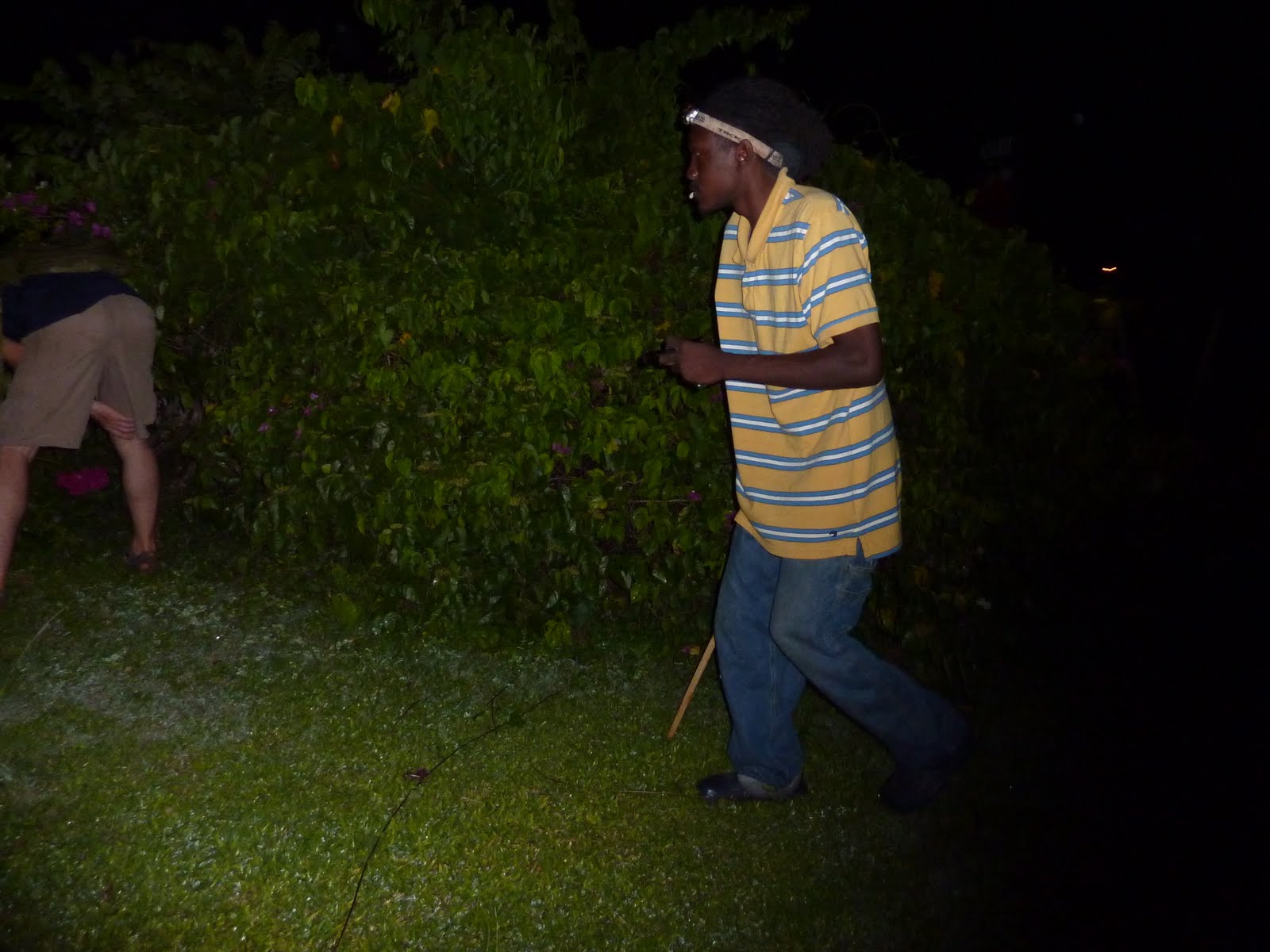
Bigga hunting crabs with his light and stick

It poured on Saturday night. Soooo...Sunday night was crab night! I called a fellow PCV, Bart to see if he wanted to come crab hunting. Apparently I had done my research well because his landlord Bigga and some other neighbors already had plans to look for crabs in the hills. I was welcome to tag along. We were dropped off by Patrick, a local taxi driver on a random residential street where Bigga had seen crabs before. We turned on our torches (or flashlights) and started sweeping the bushes for beady little land crab eyes. The suspense was quickly lost as we didn't see a singal crab on that street. "It's close to the end of the season" Bigga lamented. We had more luck on the golf course although the two crabs I managed to catch were "wash bawn" meaning they were female and pregnant. The crabs carry their eggs on the outside. Pregnant crabs act strangely. They either don't move at all or they go far from their holes very fast. They are often the ones that get run over by cars as they try to cross the street. They are also the easiest to catch. I was plesantly surprised that my crabbing companions didn't keep the wash bun crabs. Most people I've talked seem to focus more on the immediate rewards (one more fish in my pot) instead of preservation for the future (leave the fish to grow and reproduce).

A "wash bawn" (pregnant) landcrab

Bigga and his friend Bobby seemed to have super human senses. They knew exactly where the crabs were and what they were thinking. They did most of the catching and in the end they had a bag full of about a dozen crabs. Beach road, I thought, tomorrow I'm trying my luck on beach road. I had watched the experts: step on the front of the crab so he can't get you, grab it by the back, then drop it in the bag.

It rained again on Monday afternoon and cleared up just before I left the office. Another perfect land crab night. Bart came over and we armed ourselves with his head lamp and a purple bucket with lid to carry the crabs. I changed into sneakers and we left the house just after dark.

As usual, we got a lot of attention as white people walking down the street. Especially white people walking with a purple bucket and headlamp. "What are you looking for, a taxi?" "No sir!" "Oh, you're looking for crabs" Our new machete-weilding friend in a white t-shirt full of holes made his way towards us. "Lend me your light" he said as he grabbed the head lamp from my hand. I feebly held onto the elastic "No man, we naa need yuh help. We want fi catch crabs ourselves." But my protests were to no avail. He had the light and was on a mission, stabbing crab holes (and sometimes crabs) with his machete. He wouldn't give back the light, so my only option was to follow and grab the crabs after he trapped them with his machete. The rain had brought the crabs out, and after only a few minutes, we had a full bucket. As we said goodbye, the man asked for J$200 as a "tip" for his help. "We never even wanted your help - you took our light!" We didn't have any money, so he insisted we give him the crabs because we "never would have caught them without him." He continued down the road swinging his bucket of crabs cursing loudly to himself "raas, bomba clot, $200"

Back to square one! With a slightly bitter feeling, and realizing we had just scared most of the crabs back into their holes, we set out looking again. Every few feet we were approached by people giving us recipes, wanting to help catch them, and asking lots of questions. Who are we? Where do we come from? Why are we doing something so "local?" We managed to catch two crabs, despite all the attention, and turned back towards home. "I want to catch one more crab on the way back." I said.

Bart looking for crabs

We made friends with Minot who runs a Ital tea stand on the side of the road when he witnessed a crab grab my toe! Luckily Bart could pry it off but I was very glad I wore sneakers! Minot gave me some aloe to soothe my mosquito bites I had inevitably collected by walking through the brush in shorts. He had us try an herbal remedy he made to cure stomach aches and gave me a couple types of grasses to make tea with at home. His generosity and good natured spirit more than made up for our other encounter.

We reached the beginning of beach road, but the only crabs we saw were wash bawn. Through the trees I saw the sweep of flashlights. "How many yuh catch?" I shouted. The proud crabbers opened their bags to reveal about 8 BIG crabs. "Do you want one?" They fished out the biggest one and dropped him into our bucket. "Good luck!" I was satisfied: I had found my third crab on the way home after all.

A whole bag of crab!

That night I hardly slept at all. I kept waking up thinking that the crabs had knocked the bucket over and were running loose in my apartment. Around 2 in the morning they starting scratching around at the bucket. After an hour or so I got so frustrated I put them outside. Who cares if Lucky finds them: I need to sleep. I woke again at 5AM to Lucky barking. Oh no! The crabs! I run outside to see Sandy's face pressed against her screen. The bucket is still standing but Lucky has discovered it. He sniffs at the bucket, but when the crabs start to move he runs away barking. When he almost knocks the bucket over I decide they need to come back inside.

I told the women at the soup kitchen my crabbing adventure and asked them how to cook the crab. Most people either boil them with salt and scotch bonnet or they pick out all the meat and curry them. I didn't have any curry powder and I don't like cleaning crabs while I eat them. So, I decided to cook them like my grandmother cooks Maryland blue crabs: clean them, then sautee them with onions, white wine, and lots of old bay. Two problems: 1) There is no old bay in Jamaica and 2) There was no visible way to pry off the backs like there is with Maryland crabs. The first problem was easily fixed by substituting jerk seasoning (while a little sweeter they smell remarkably similar). I fixed the second problem by boiling the crabs first with the salt and pepper like the soup kitchen ladies prescribed. They were fighters: I had to use my machete to get them into the pot.

Land crabs in my pot

As they boiled a greenish brown scum accumulated on the surface of the water. That can't be healthy. I made sure to scrub all the crabs really well after boiling them to get off the dirt that had accumulated over their lives: again something I hadn't encountered with ocean crabs.

Post-boiling the crabbies hang out in my sink

When they were nice and clean, I cooked them so my family would be proud. They tasted good, but the meat wasn't quite as sweet as the crabs back home. Afterwards, I felt vaguely sick to my stomach. I couldn't tell if I was actually sick or if that was just the feeling that comes from catching strange creatures in a strange land and cooking them yourself. Sandy's sons caught crabs when she lived in the Virgin Islands. She said they kept them for about two weeks feeding them cornmeal to clean their system and coconut to sweeten the meat. Next time, I might try that although I don't know if I would want to keep the beasts for two weeks. All in all it was another great adventure.

Nice and clean and ready to eat

Saturday, June 5, 2010

Mi Yard

My house (left) Sandy's house (right).
If you zoom in you can see some blackey mangoes hanging between our units.

Mi Yard is actually the name of a local bar. There is a large sign out front where red tube lights illuminate MI YARD through a drifting haze of ganja smoke. Music is usually blaring and a group of Jamaican men can be found around the bar. This is not my yard.

Mi yard is small and quiet but filled with life. There are four housing units. Three of them house Peace Corps volunteers (me, Curt a second year volunteer who leaves in July, and Sandy a third year volunteer and my mentor at NEPT who will be leaving in September). Miss Beulah and her daughter Maureen live in the fourth unit. Miss Beulah runs a shop in the front of the yard next to the street where all the children stop on their way to and from school to buy suck-sucks (bags of frozen juice), sweeties, and other snacks. I found out that suck-sucks are called serve-me-longs if they are frozen because "dem serve yuh long time." Maureen runs a school supply shop right next door. She sells pens, pencils, erasers, and all sorts of paper and notebooks but I've only ever seen students buy marbles and stickers.

My house is all the way at the back. It has three rooms (kitchen, bathroom, and bedroom) and hot water and air conditioning, neither of which I use. I've been living here for two weeks and neither the electricity nor the water have not shut off yet. All in all it is a very nice set up for a Peace Corps volunteer.
Lucky, our yard dog. He's a little crazy, but he helps keep the yard safe.

Our yard has a dog, Lucky, who Sandy found on her way to the Royal Palm Reserve (run by NEPT). Sandy thought he was black at first because he was so covered in fleas. She took him in and has taken great care of him. He is very Lucky that she found him. The yard also has two cats, three mango trees, wild basil, and a breadfruit tree. I'm hoping to add to the garden as soon as my compost matures. I bought a machete the other day, which is the tool of choice in Jamaica (pronounced Ma-shet: no e on the end). Need to cut a small tree? Don't use a saw: here's the machete. Need to dig a small hole? Don't use a trowel, the machete is right here. The jellyman uses a machete to chop open coconut. The cane man uses one to peel sugar cane. I'm a little embarassed to use my machete because its so clean. The wood on most Jamaicans' machetes is dark and smooth from use and the blade has been filed many times.

Mangoes from my yard: East Indian (left) and blackey (right)


There are many different types of mangoes on the island and they all have several names. Our yard has small blackey mangoes (so called because of the black spots, also called green gage or gatey), east indian mangoes (my favorite), and a large mango that Maureen and Miss Bula call "the big ones." Its mango season now, so I've been enjoying all of them!

The front gate and East Indian mango tree.

It's also land crab season. I visited Kool Runnings water park last weekend (Yes, I rode the Jamaican bobsled. Several times in fact) and there were about fifty of them swarming around the restrooms. One of the employees was dropping as many as she could into a bucket to take home and cook! I've been keeping my eyes out for them in the yard, but so far I've only seen them as road kill. There are several crab holes at the catholic church, so I might bring a bucket with me on Sunday.

Wednesday, May 26, 2010

War in Kingston

This morning I was planning on taking my first water samples at the Blue Flag properties on Beach Road in Negril. However, the plans were detained because the Ministry of Health (where the samples are usually tested) is closed due to the recent turmoil in Kingston. It has made international news. (There was a good segment on NPR this morning.)

Disclaimer: What follows are not my personal views or the views of Peace Corps, only what I have heard and read from local sources.

It started last week when Prime Minister Golding announced that Justice Minister Dorothy Lightbourne would sign the authorization for the extradition of Christopher Dudas Coke to the United States. The U.S. government requested the extradition of Dudas last August for drug and gun running charges. Dudas is based out of Tivoli Gardens in west Kingston. Last Friday, newspaper pictures showed that the neighborhood had been barricaded and was being patroled, presumably by local gang members. On Saturday what most Jamaicans have been referring to as "the war" began. Three police stations were attacked, one set on fire, and two fired at. The Prime Minister declared a state of emergency for the Kingston and St. Andrew parishes on Sunday which can be used as a rationale for suspending civil liberties and will last for a month unless police deem it safe to cease or parliment deems it necessary to continue. Unfortunately, many civilians did not leave before the violence started and are caught in the crossfire.
Both the police and the military are working hard to restore order to the region and to capture Coke. I was only able to talk very briefly with my host mom from Hellshire who works with the police in Kingston to assure that she was alright. Most of the violence has been concentrated in Kingston, but some has occured in the parish of St. Catherine as well. In fact, on Monday the flat bridge in Bog Walk, very close and en route to Ewarton (my old home) was barricaded. Fortunately, my host mom in Ewarton returned from her conference late enough in the afternoon that the blockade had been dismantled.

Everyone I have spoken with are very troubled that this is happening in the capital. Some see it as a potential "blessing in disguise." People are hopeful that this is a turning point for Jamaica to rid itself of the mafia system for good and provide for people's needs by other means.

Everyone has their own theories about where Dudas is, and wild rumors are flying. In any case, myself and other Peace Corps Volunteers are safe and being well looked after.

Saturday, May 22, 2010

It's Official!

I'm finally a real Peace Corps Volunteer (PCV)! I'm serving with NEPT (Negril area Environmental Protection Trust) in Negril which is all the way on the westernmost tip of the island. When I applied to Peace Corps I never expectedI would be nominated to Jamaica. When I was invited to Jamaica I never I would be assigned to a site in a beautiful resort area like Negril. Now that I'm assigned to work in Negril I've decided that I should give up my expectations! I spent three days in Negril two weeks ago, and then returned to Kingston last week for the remainder of training which mostly consisted of playing in the pool and saying goodbye to other Peace Corps Trainees (PCT).

Yesterday Peace Corps Group 81 graduated from training and became real volunteers! The ceremony took place at the U.S. embassy and was overseen by the chargé d'affaires because an ambassador is not currently assigned to Jamaica. We were featured in an article in today's Observer (the main newspaper in Jamaica). After two months of training and looking forward to finally being a PCV instead of a PCT, the actual swear in ceremony was a little anticlimactic. I returned to my site last night and I'm ready to get started!