The title of this blog is taken from my favorite movie: The Princess Bride. Miracle Max and his wife say "Have fun storming the castle!" as Inigo, Fezzik, and Westley set off on their big adventure to save the princess. And that's what this blog is about: adventure, fun, and saving the world.
Showing posts with label Peace Corps Jamaica. Show all posts

Tuesday, May 1, 2012

Treasure Beach Triathlon

Sammi Travis, a fellow PCV and good friend, and I decided last year that we would enter the Treasure Beach Triathlon this year. Treasure Beach is a windswept tourism town on the southcoast which can tend to be a little lonesome if you don't bring your friends. Luckily we had ours - a whole house full of them. As my friends and family know, I am not a sports person. I quit the T-ball team when they took away the T. I got cut from the volleyball team in 8th grade. I always chose table tennis over basketball in gym class in high school. Needless to say, this was my first race. I might as well make my first race a triathlon! Training would be an excuse get fit, and a great way to celebrate two years of service in Jamaica. As it turns out, neither of us really trained, but we both won the purple monkey award, a special award for those who come in last place!

Receiving the purple monkey award.  Yes, it looks red to me too.


The triathlon consisted of a little bit of open-water ocean swimming, a lot of biking on dirt trails and backroads, and to top it all off a healthy dose of running. We all lined up on the beach, and then charged into the sea at the whistle. My bathing suits had been destroyed by the salt, sun, and handwashing, but my shorts and tank top worked fine for me. I backstroked my way towards shore, where Sammi, being a faster swimmer, was waiting for me. Being slightly unorganized, as things tend to be in developing nations, there was no water at the end of the swimming of the race. A little parched, we donned our clothes and helmets, hopped on our bicycles and started riding.


Within the first 5 miles of riding I passed a racer sitting at the side of the trail with his out-of-commision bicycle. Being the good Jamaican that I am I stopped to see if he needed any help. Roadside assistance in Jamaica is wonderful. If you are stopped on the road for any reason most cars will stop and ask if you need help. And most of those drivers know some mechanic work to help you too. Sammi road up a little later and the two of us helped him patch his bicycle tire, another skill we had learned in Jamaica. Unfortunately, while we were helping him every last racer passed us! Sammi and I are slow people in general (late because I stopped to smell the roses individuals) so this didn’t really bother us too much.

In fact, soon after we started riding again we passed some large mango trees with people eating mangoes below them. Still feeling thirsty from the swim, Sammi suggested we stop and join them. Hey, we’re already in last place and I made us stop to fix the tire, why not? We stopped and ate and chatted, and ate some more. We tried three varieties of mangoes, and got invited back to load our bags before we left the next day. Bellies full we got back on our bicycles again. Well, apparently word got out that there were “two white ladies climbing mango trees!” because every water station we passed people asked us how the mangoes tasted!


We did it!!

We parked our bicycles at the finish line, and began the run. By now, the sun was hot, and we were both tired but happy. As we were coming in for the home stretch, we realized that we were going to run past the house that we were staying in. We had brought two red stripes with us for a celebratory toast, and the opportunity was too fortuitous to pass up. I popped into the house, popped the bottle caps, and popped back onto the road. We left the bottle caps on the beers, which is a Jamaican style of serving beer, which made them convenient travel mugs. We crossed the finish line, beers in hand, to the cheering of our fellow Peace Corps Volunteers, and cries of “we’re going to put you in our newsletter!” from the Treasure Beach women’s society. The triathlon was an allegory for the way we live our lives, its not about the destination, it’s about the journey. The purple monkey will sit proudly on my shelf as a reminder to stop and eat the mangoes!


Proudly cradling our red stripes after the race


Saturday, September 17, 2011

School Garden Part 3


Proud farmers display their produce

The school garden was a great success last year. After our harvest of string beans and turnips we planted and reaped lettuce, tomatoes, sweet peppers, hot peppers, and carrots. We had such a bountiful harvest that we could not use all of the vegetables at the school. We sent some of the produce to the local shops and market and a lot of it to needy families. The profits from the garden will be used towards seeds and fertilizer for this school year and for the school nutrition program (more to follow). We are looking forward to planting more string beans, carrots, tomato, broccoli, and lettuce within the next month. Our sweet pepper and hot pepper plants are still bearing along with scallion and thyme the key ingredients in every Jamaican dish.

A local shopkeeper sells our tomatoes in his shop and at the market

Summer is gone...Back to School Fun!

Yesterday was the second full week of school. School let out early on Friday afternoon, as usual. I stayed later to let students swap library books. They were excited because they get to take two books on the weekends. However, after library time was long gone I was surprised to see a group of students still hovering in the school yard, debating the differences between sharks and dolphins. This is a Friday afternoon! Don't you want to go home throw off your school uniforms and have some fun? I guess I shouldn't have been. Jamaican children love school. In Westphalia at least children would much rather be in school than at home. Summer was boring and they are so happy to be back in school again. The teachers tell me it's because they have too many chores to do at home. I'm not sure what it is but Shhh! don't tell them they're not supposed to like it!


At the end of last year I asked my students if they wanted to continue reading classes over the summer, expecting them to say no. Another surprise: yes miss! How many days a week would you like to have them? Everyday miss! But you wouldn't want to have it all day, just for about an hour or so? All day miss! We compromised with reading class Tuesday, Wednesday, Thursday mornings and swimming lessons at the river on Fridays when most children help their parents on the farm. Swimming lessons were large and sometimes more fun than swimming. Reading classes were small but successful. Between November and July one student improved by 3 grade levels, two students improved 2 grade levels, and 8 students improved 1 grade level. Most of them are still below grade level, but hopefully that will change this year!

Mondays, Saturdays, and some Sundays were dedicated to water work days with a core group of men in the community laying water pipe to the school. Thanks to Appropriate Projects my fellow Peace Corps Volunteer Daniel McDonald's parents Judy and Doug McDonald, the National Water Commission, and community members the pipe has nearly reached the school (only 20 lengths to go!). Work days were frustrating at times due to lack of support, but we have successfully carried, dug trenches for, joined, laid, and buried over 150 20' lengths of pipe.

I also had several visitors this summer, and hurricane Irene was not one of them! My friends and fellow Peace Corps Volunteers Sammi Travis and Patrick Marti came on a river day. Two new Peace Corps Volunteers Sarah Marshall and Crystal Aeppli came and helped Fitzroy and I weed out the garden and carry two inch pipe on their shoulders - what great sports. Thank you guys!

Mom and Dad enjoying Jamaica's natural beauty.

Finally, my PARENTS came to visit me in Jamaica. Which was BIG NEWS in Westphalia. My parents kept asking "When can we come visit?" My community kept asking "When are mommy and daddy going to come look for you?" and I was the major stone in the road keeping these two groups from meeting each other. They come very different worlds and I, living somewhere between the two, was afraid I would be mortified by their interactions. However these two forces were bigger than me, and they arrived mid-July. My fears were misplaced. My parents were wonderfully flexible. They stayed in Westphalia for a few days and took bucket baths like pros! My community members were very welcoming opening up their hearts and homes and sending them on their way with freshly ground coffee. I had wild dreams about us riding bikes through the mountains for two days but when one of the valves on the tubes sprung a leak we had to content ourselves with a rusty old truck ride. At one point during the ride, Dad looked down through the holes in the rusted out bottom of the truck to see a fire below his seat. Luckily, our driver was a mechanic and after whacking the battery with a wrench a few times it was as good as new. I am used to drivers moonlighting as a mechanics but my parents were remarkably cool about it as well. We had several more adventures far from the traditional all-inclusive Jamaican vacation including touring a bammy factory and swimming in one of Jamaica's many "blue holes" which are gorgeous clear blue water usually with a waterfall as a backdrop. We topped it off with the highlight of my summer - turtles. We helped 148 baby turtles hatch and watched a mother lay another 100 something eggs. I got to swim out to sea with the babies until they tucked their flippers into their sides and drifted out with the current.

There were literally HANDFULLS of turtles. They are so determined and independent from birth - they know exactly where the ocean is and head straight for it. As we say in Jamaica "Dem no business wit nobody."

Fitzroy, my community counterpart and right hand man for our water project and school garden, and I also got to do some traveling including visiting his daughter in Trinityville, St. Thomas and going to the yearly Jamaican Agriculture show in Denbigh, Clarendon. All in all, it was an enjoyable summer and I'm excited for school to be back in session again!
Den den, Fitzroy and I pretending riding Jamaica's newly reinstated train at Denbigh.

Saturday, May 28, 2011

Labor Day

Pipes donated by Appropriate Projects were buried to provide clean water to the school.


Parents paint the school yard walls in Westphalia All Age School's colors: green and gold.


May 23rd was Jamaica's Labor Day. Labor Day in Jamaica is not a random day off like in America, it is a day of labor for the community. Parents and children from all over the district flocked to the school on Monday to paint, clean, and lay pipe. The school looks so much brighter now, thanks to everyone's hard work!


Students, present and past, working together to help their school.


Courtney and Joshua help stretch two gallons of paint to cover all the walls


Tuesday, May 10, 2011

Carnival

Carnival Paraders take a break after several hours of walking in the hot Kingston sun.

Just before attending mid-service conference I got to witness Jamaica’s carnival. Carnival is a Caribbean tradition which originally started in Trinidad and Tobago and involves scantily clad men and women dancing in drunken orgies to ward off duppies or evil spirits. Needless to say it was quite and experience. It was different from most Jamaican parties in a few key ways 1) it was during the day 2) it was moving (a parade) and 3) people were dancing the whole time. It was like a giant conga line all throughout Kingston! I went with a busload of people from my community, most of them men in their early twenties (or to steal a term from Taylor, a fellow volunteer, the idle bwois). Up until the trip I’d had a hard time interacting with them. I’m mostly friends with the kids (15 and below) and the grandparents (40 and up). The kids are still innocent, fun, and up for anything and the grandparents are mature enough to carry on a decent conversation. When I'm talking to women my age the conversation usually peters out after I ask how their children are. If the men don't try to hit on me, the conversation usually stops right after hello.

Going out with the idle bwois was a real bonding experience. We caught the parade in New Kingston, near to the Peace Corps Jamaica head office, an area I am very familiar with. For the first time, I was showing Jamaicans around Jamaica, a wonderful feeling! I kept them from getting lost and they saved me from a creepy clown who talked in a high pitched squeaky voice. Of course the majority of our interactions since that day have been us saying the same greetings as always but in the creepy clown voice. The conversation isn't exactly gushing forth, but hey, a bridge was crossed and I don’t feel so uncomfortable walking through the square anymore.

Rejuvenation!

The past few months (January – March) were very difficult for me. I just got back from our mid-service (yes its been a year!) conference where we talked about the volunteer life cycle and the one year slump. Most volunteers have a difficult time right around the one year mark. It was definitely a slump but I’m pleased to announce I’m on the way up and out! The biggest contributing factor was my recent trip to the U.S. for Easter. Thank you, thank you, thank you to my family for listening to me complain and giving me so many pep talks. I am energized and ready to dig into the second year of service! It should be noted that most of my community says foreign was good to me, that I’m glowing now, and also that I look so fat and pretty (a major compliment in Jamaica).

I was really trying not to go home for the full two years in order to totally immerse myself if something different, but I didn’t make it. I managed to explain to my community that no, I don’t have money my family is paying for the ticket (sorry Mom and Dad you might get begged big-time when you get here) but I still heard a lot of ridiculous requests. Foreign is a magical land where geese lay golden eggs and ipods grow on trees. So I was SUPPOSED to carry back several computers, three pairs of shoes, a blackberry, pizza, a variety of gourmet cheeses, pounds of broccoli seed and a few mp3 players. I ended up bringing 100 lbs of used books that students from Loomis Elementary School generously donated and some soaps and candles that we had gotten at one time or another and never used. It was tricky, but I think I managed to walk the fine line between every parent in the district asking me to pay their child’s school fees and insulting someone close to me because I didn’t “carry something back for them (do please do).” The Jamaican pleading “do” and “come now” are so hard to say no to!

Grades 6-9 pose for a class picture with their new books on Literacy Day 2011

Bringing the books to the school was a major feat which involved a car, one airplane, three taxis, two buses, and 17 hours of travel time. It also included me getting stranded in downtown Kingston (yeah the dangerous part of the island) after dark and two very kind strangers, angels really, each carrying a 50 lb box of books about 7 blocks for me. To celebrate, we organized a last minute Literacy Day 2011 celebration yesterday which was held, you guessed it, today! As a procrastinator, Jamaican planning is just my style! It was a huge success. All the students are SUPER excited about the new books and better still SUPER excited about reading. The principal and I had to forcibly herd the children out of the library appeasing them with promises that they could check a book out on Thursday once they have been organized.

Reading, books, and more reading!

Everything is looking up. We’re going to build shelves for the books, move the library into a bigger room, and put in a computer with reading games. Our garden is looking fantastic (who knew everything could grow so much in three weeks?!) and students are EATING VEGETABLES EVERY DAY and even taking some home for the rest of their family. Also, even though the National Water Commission is full of false promises and bureaucracy it looks like not all hope is gone for the community water project after all. Hopefully, more on that is to come. Until then, our eyes are wide and dreamy and we look fat and pretty!

Thursday, March 24, 2011

Am I encouraging racism?

This past weekend was a big one for my host family. Lion's Canadian boss came to visit Jamaica and took all his Jamaican farmhands out on the western side of the island. I went to Falmouth with my host mom to celebrate my one year anniversary on the island with some other Peace Corps volunteers. When they both returned home, I overheard the comparison of their trips and resultant exposure to "how white people stay." The things that I heard filled my head with questions. I jotted down a few outstanding quotes. "Black people selfish. White people giving." "White people nice and loving, black people a sh*t." "These [white] people don't have money either but they still go out and see the place. White people interesting more than black people. They enjoy life more." "White people treat we better than black people."

Color stereotyping is rampant in Jamaica, especially in the country. Light skin means intelligence, beauty, and success. Darker skin is associated with laziness, ignorance, and crime. Good hair is straight and long. Bad hair is short and curly. Parents tell their children that they are black and ugly. Some men and women use laundry "cake soap" which contains bleach to lighten their skin. Many women weave extensions into their hair or cream their hair to make it straight. African Americans deal with these same issues especially in urban areas, and many sociologists say that these attitudes stem from colonialism and slavery. However, this was different. Adults were justifying their intangible racist ideas with me as a real life example. When I tried to argue that color had nothing to do with it my host mom scoffed and reproachfully told me that black people are worthless. How can someone live forty-four years and think that about themselves?

Children's voices carry the most fundamental ideas of a culture. The children often tell me that I'm not like other adults or teachers. I play with them, give them attention, and don't beat them. To them, those qualities are inextricably linked to the fact that I'm white and have "pretty tall hair." My neighbors and community leaders tell me they need more white people in their country to make it a better place. I find myself wishing I could perm my hair, dye my skin brown, and prove that personal qualities and color are not related. Maybe shaving my head would show the young girls that you don't have to have long hair to be pretty or nice or respectful.

Interestingly, I have encountered the opposite attitude amongst wealthier and better educated Jamaicans. This is a hopeful sign that changes are beginning, but these changes are still nascent in Jamaica.

Friday, January 14, 2011

School Garden Part 2


We've started harvesting! The school has turnips (radish) and green beans at lunch now. Some of the poorer students are allowed to take vegetables home with them. We've raised J$400 by selling turnips at the market to buy some more seeds. This past week we planted watermellon, tomato, and lettuce seeds along with our sweet pepper suckers. The students are excited to see things growing, the farmers are enjoying teaching the students, and I'm happy to see more nutritious lunches being served.

Saturday, January 8, 2011

Merry Christmas, Happy New Year!

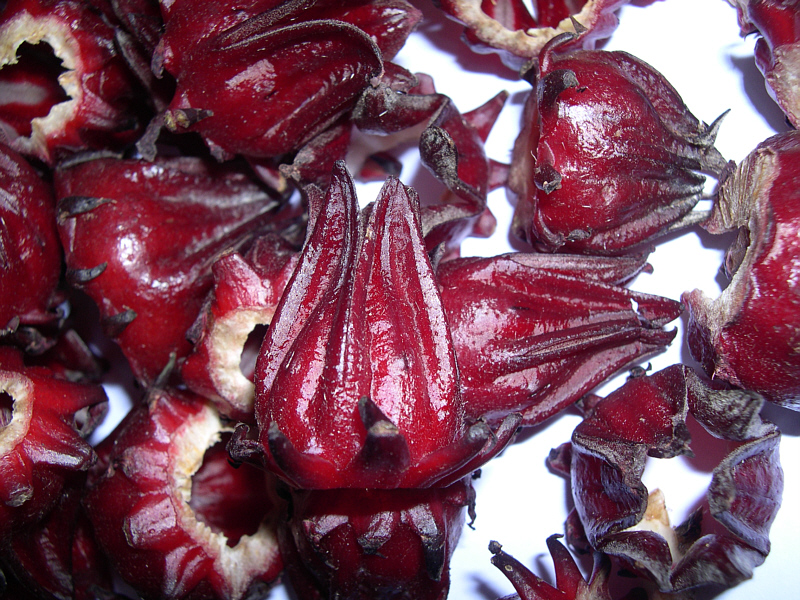
This Christmas was my first Christmas away from home. ::tear:: I won't lie. At first, it was terrible and lonely. I got back from a hiking trip on Christmas Eve to find that everyone in the house had gone to town to do last minute Christmas shopping. I made myself pancakes for dinner and went to sleep at 8. When you go Christmas shopping in Jamaica you don't focus on buying presents for other people. You shop for new sheets, curtains, and paint. Why? Because the Christmas tradition in Jamaica is similar to the spring cleaning tradition in America. I awoke at around 5 AM to the sound of a couch being used as a battering ram against my door. (Not a problem because I had gone to bed so early the night before). Time to empty out the room, mop the floor, and wash the walls. Six hours later we went on a tour of each others rooms OOoing and Ahhing over the new made-in-china sheets and curtain sets. Also, every room got a new set of lacy doilys which matched the curtains and sheet sets for the top of the bureaus. If you see a home decoration that has "old woman's home" written all over it you can be assured that its the apogee of Jamaican interior decorating style. For our community's womens' group gift exchange I made sure to get a faceted pitcher set that my great grandmother would love. Yes, I was upset that instead of spending Christmas morning opening presents I spent it scrubbing the floor. However, the morning of hard work was soon rewarded with Christmas fruit cake, (Much better than American fruit cake: its moist.) sorrel, (a purple drink made from this and ginger) and Christmas wine (always administered with the precaution "Mind yuh drunk yuh know."). The afternoon was spent visiting neighbors, relatives and friends and begging the three aforementioned Christmas delicacies. By evening, you could tell that some of our visitors had visited most of the 116 households in the district.


After Christmas dinner (gungo peas and rice, fried chicken, and salad) I joined some of my community members in the shop out front for a Christmas drink of Dragon Stout, Supligen, and white overproof rum all mixed together. It tastes better than it sounds. We put on "holdies" or old time reggae and started dancing, which, as people who know me know is one of my favorite pastimes. One of my best friends in my community, Fitzroy (farmer, red cross volunteer, genuinely nice person) convinced me to go to a party, which I normally avoid due to incessant sexual harassment, saying he would be my protector. He stayed true to his word and we danced until morning. We visited with friends, watched a machete fight caused by two drunken youths stoning a woman's house, and had a genuinely good time.


The next day was the Christmas tree lighting hosted by the chruch. A Jamaican Christmas tree lighting is basically like a talent show to raise funds for the church. The hostess calls random audience members names. If she calls yours you must sing a song. If you can't sing, you dance. If you can't dance, you pay money. As I entered the church one of my friends warned me, "You know they're going to call your name tonight. You better think about what you are going to sing." He was right. As I walked up to the front of the church, I reached my hand into my pocket to pull out the cash I had stored there after hearning the warning. However, once I got up there I had a sudden burst of courage. I found myself saying, "I'll dance." So, to a standing ovation and a lively reggae beat I started dancing. I think I brought more funds than anyone else that night because they called me up for an encore. The rest of the service was wonderful with candlelight singers, skits, raffling of presents off the tree, and the gift exchange. I got a Spencer's gift style revolving lamp with fish on it. Joy to the World!

Monday, November 22, 2010

No man, yuh kyann manage dat. (Yes I can!)

My days seem to consist of several moments of complete confusion strung together by alternating bouts of comprehension and helplessness. I have come to the conclusion that this confusion and helplessness are largely due to my education and living on my own. I have been training my whole life to block out distractions, concentrate on the task at hand, working on computers and in books. I'm very good at blocking out distractions. So good, that I don't see so-and-so's truck parked by the school or notice the new rain-catchment tank in the neighbor's yard. The Jamaicans in my community have superhuman observation skills. A red dot on a hillside is Ms. Daisy. They can hear the bus on the road from over a mile away (although once my host sister did confuse it with a tractor). One woman in the district who is particularly observant (and particularly gossipy) can glance into a passing bus and can tell you exactly who is leaving Westphalia, where they are going, and about what most everyone is doing there. News in general spreads extremely fast here, which I guess might be characteristic of most small towns. (Westphalia had about 500 people.) It's great for advertising community meetings but often leaves me feeling out of the loop. For example, the other day I was wrapping up a conversation with a friend so that I could visit with a neighbor down the street. When I mentioned where I was going, the friend said "Oh that neighbor isn't at home. I think he's at the nine-night in Resource." When I asked him how he knew he said that he heard his voice a while back while were were talking, and the obvious place for him to be going at this hour was the nine-night. He probably got there about 15 minutes ago. Didn't you see a lot of people going up the road through that hole in the bamboo fence? No, I was paying attention to our conversation. I didn't see anyone going up the road, and I didn't hear anyone's voice either. Are you sure it was him? Sure enough, as the neighbor picked up my phone call I could hear the duppy band in the background. He was at the nine-night.

I have had a great many humbling experiences in Peace Corps so far. Not only have I been training to block out distractions my whole life, I've also gotten used to living on my own for the past five years. Now I'm going from cooking for one to cooking for 11. The pot is a lot harder to stir! Turning on a sink is a lot easier than pouring water from a large basin. I'm really fast at working on computers and with spreadsheets, but I'm pretty slow at hand washing. I can open a can easily with a can opener, but the school doesn't have one. It turns out I'm pretty clumsy with a knife. Probably the number one skill that Peace Corps Volunteers should have is skill with a knife. Other skills that would come in handy are construction, farming/machete weilding, and carrying things on your head. In any case, I'm lousy at all these pratical skills. I never realized that I lived such a stoosh life. All of these changes coupled with the stereotype that white people are weak result in me hearing "No, you can't manage that." several times a week. Most of the time its people taking care of me and protecting me, but it gets frustrating sometimes to hear that. Right now there are some things that I can't manage. Hopefully though, at the end of two years, I'll come back swining a machete with a bucket of water on my head, and my community will be literate and have piped water.

Thursday, November 4, 2010

Tropical Storm Tomas


Everyone in Jamaica has been listening to the weather with rapt attention for the past week as Tropical Storm Tomas was approaching the island. Peace Corps consolidated the three "most remote" volunteers on the island which, unfortunately, I was one of. Being a volunteer through Peace Corps has many advantages. Complete medical coverage, language training, security and housing support, etc. However, you are also at the beck and call of the Peace Corps. I didn't really have a say on whether I would move from Negril, or on whether I would consolidate.


Luckily, the storm passed over Westphalia with some rain and a slight breeze without damaging anything or anyone. However, we made sure to take all the necessary precautions. I got the call from Peace Corps and packed my bag with all my important papers and possessions. I put all my remaining belongings on my bed, covered them with a tarp, and tied it tightly to the four bed posts. That way, if the roof came off nothing would get wet or fly around the room in the wind. We also made sure to secure the roofs of our houses. Wednesday was spent shoveling rocks into bags, lugging them up the ladder, and placing them around the border of the roof. The sound of hammers echoed all over the community as we happily nailed sheets of zinc over all the windows. Pictures will follow the next time I have access to internet, but I'm heading back up to my community now!

Friday, October 29, 2010

School Garden: A dat wi did wan long time.

GG uses his machete to dig a hole for a schotch bonnet pepper sucker.

The school has talked about starting a garden for a long time. This past week it finally began! Community members brought tools, knowledge, and expertise. The school brought the seed and fertilizer, and the students brought the labor and their questions. So far we've cleared some land, started a compost heap, and planted hot pepper, coco, sweet pepper, plantain, and flowers. We'll use the produce in the school kitchen and if there is left over food we'll send it home with the children that might need it. We've been having a lot of fun even in the rain. I just hope they start listening to my pleading "Please don't run with the machete!!"


Fitzroy shows the students how to protect the sweet pepper nursery from the rain with banana leaves.

Too much information


The view from the school yard yesterday afternoon. This is only half of the rainbow!

I'm still having a wonderful time in Westphalia. I've started learning more about the people who live there: how they act, what they like, and all the familial relations. In some cases, too much. A past principle threatened me with a gun after I wouldn't help him embezzle funds. These are my children but that one was an accident with a prostitute. His mother went to jail for throwing her baby into a pit latrine. I caught those third graders having sex the other day. She stole from him and blamed it on the other guy. My stepfather is trying to sleep with me. Look at his stomach (lifts up his shirt) he just had surgery! That boy steals my crops all the time! I don't know why after seeing me for a month people approach me with all this information. Is it because I'm white? A peace corps volunteer? Would tell these things to any stranger who visits the community? This happened a bit when I was in Negril, but its much more frequent here.

I never really know what to say or how to react. Sometimes I just change the subject. A teacher at the school told me she never acts the information that she hears because she doesn't know it is true. If a child is legitimately confiding in me shouldn't I at least investigate? How would that affect my reputation and my role as a Peace Corps Volunteer? How would I even go about doing anything if there aren't any local authorities in the community? For now I'm listening, forgetting some information, and being as supportive as I can without involving other people.

Smiling faces after eating birthday cake and ice cream.

Thursday, October 21, 2010

Put the fun back in funeral!

I recently went to my first Jamaican funeral with Mr. Campbell, or as his friends call him "Youn." He is the president of the farmer's group in Westphalia. His son-in-law's father who lived in the neighboring community of Resource had died at 80 in late September.

Most people in Westphalia will dress up for church but wear their "slippers" (flip flops). They carry ther shoes in a scandal bag (plastic bag) to change into once they get to the event so that they don't get mud on their shoes from the dirt roads. So, off I went dressed in my Sunday best, shoes in my right hand, umbrella in my left. We both made sure to carry our umbrellas, as the frost was thick when we left the house. (Frost = fog in Westphalia.) Even though we both "wouldn't mind if the rain never fall" it did.

It is a long journey from Westphalia to Resource which can be made a little shorter by taking a shortcut. After asking several farmers we found the shortcut and started down the little trail. Everything was fine until the rain started. The steep dirt track turned into a slip and slide. Before I knew it I was doing a backbend with both my hands on the ground behind me. In trying to save my dress from getting dirty, (I wouldn't want to perpetuate the stereotype that white people are dirty.) I had sacrificed my thumb. I wrapped Mr. Campbell's sweat rag around my thumb and grasped my umbrella tightly to stop the bleeding. We stumbled the rest of the way to Resource managing to arrive relatively clean. We arrived at the grave site and a little old man promptly grabbed my hand and started rubbing it on his belly slurring something uninteligible. I later found out that he was the brother of Sadpha, the deceased. Despite the rain, the church was full. (Jamaicans don't usually go out in the rain.) Sadpha had seventeen children and it was very obvious throughout the service that he was well loved and a great defender of his children. I was surprised to see more smiles than tear, people dancing and clapping along with the songs, and a genuine feeling of celebration in the air. As we climbed the hill back to the gravesite, Mr. Campbell explained to me, "Me don't like look pon no dead. Me don't believe so much inna dead. Nobody nuh nutten when dem dead. Dead don't matta. Yuh only a somebody afore yuh dead."


We arrived back at the gravesite where Sadpha's closest friends could be made out through a haze of ganja smoke, struggling to walk straight, and liberally pouring more rum. A crowd gathered around the sepulchre as the paulbearers slid the casket in and started to lay the final concrete blocks around it. A strong alto strain cut through the fog, "If you miss me...Don't come searching." Harmonies from the rest of the crowd filled out the song. "And if you don't see me. remember I'm gone." I started to think, why are American funerals so sad anyway? Mr. Campbell said it well. A person is only a person when she is alive. Death doesn't matter as much as life.

Wednesday, October 13, 2010

Back at Site

Community members repair the road with tires and stones. They've already repaired this road once before in this way only to have it wash out again.

I got back to Westphalia last Monday. Peace Corps drove me as far as they could, about half way. We were surprised to see that the road had completely collapsed: classic case of the Jamaican understatement - American literalness clash. "I don't really sure about the fish" means "We don't have any fish today." "Do you like cats?" means "Ten cats live at your new home. Are you ok with that?" "Mi soon come" means "I might not get there for an hour." AND "The road block" means "The road has completely collapsed." (Ok, so maybe "soon come" should be in another category along with "When I come back" and "Just a minute." These phrases are great because they are vague. You can use them anytime! They can mean exactly what they sound like, the opposite of what they sound like, or anything in between.)


School children wave at the helicopter of food sent by the OPDEM (Office of Disaster Preparedness and Emergency Management)


Lorna, who lives in Westphalia walked down to Mavis Bank, filled her backpack with Ackee, and was hopefully trying to hitch a ride back up.

After walking around the collapsed road, calling every community member I knew, and waiting for a few hours, I managed to charter a taxi up the hill. The ride was bumpy, but the driver was very good. There were two turns that made me hold my breath. The rains had washed out much of the dirt below the road. I understood why the driver had refused to take more than one. A few pounds more and we would end up in the river! The car took me as far as it could go: still about an hour's walk from home. I lugged my bags with the help of my new community members, feeling silly that I collected so many books at the Peace Corps Conference.

Helping distribute the food from the helicopter made me realize that I NEVER EVER want to be a disaster relief worker. Westphalia is a farming community so people had plenty of food despite the road and rains. Still, everyone was quarreling, machetes were waving, and children and old people were being shoved around. It made the soup kitchen look like a well rehearsed ballet.


Today, I ventured out of the community to work on a water project with Adam, a fellow PCV in Clarendon. The road had been filled in by community members with tires, stones, and dirt. It's great that the road is passable now, but everyone says that a better solution is needed. This is the second time that the road has collapsed there. The first time they repaired the road in the same way so the next heavy rain will wash out the road again. Power was restored on the 5th.

The past two weeks in Westphalia have been WONDERFUL. I've been visiting the school, hauling water from the river, learning to pick coffee, caring for the 9 puppies in my yard, and introducing my family to Pad Thai. We had our first community meeting last night which over 60 people attended. The community members have big dreams for piped water, smooth roads, a community center, and more employment opportunities. I have my personal dreams of riding my hypothetical donkey named Clementine, raising chickens in the back yard (we're building the coop Saturday with a neighbor!), and wielding a machete like a pro throughout every footpath in the Blue and John Crow Mountains.

Girls in grades 2-5 at Westphalia All Age School. First and third from the left are part of my host family.

Friday, October 1, 2010

Landslides at my new site

The Peace Corps Jamaica country director called me in early August to informed me that my safety and security had been compromised. While Negril is a wonderful spot with a relaxed atmosphere, sunny climate, and low crime rate there is an active sex tourism industry. Part of my work with NEPT involved implementing the Blue Flag Programme at the various resorts to try to encourage eco-tourism as an alternative to sex tourism. The typical sex tourist in Negril is a white woman who finds a dread-locked companion in a union commonly termed "rent-a-rasta." Sexual harassment is present all over the island and is something that you deal with whether you are American, Jamaican, male, or female. However, Negril's sex tourism industry naturally fosters harassment of white females in Negril. While I thought I was handling most situations fairly well, Peace Corps told me that I was no longer safe in Negril and that I had to move.

Due to the situation, I was faced with an opportunity that most Peace Corps Volunteers never get to experience: choosing my own site. My ideal Peace Corps service would be in a small rural area with a strong sense of community. The people would be motivated and hard-working but might lack the formal education or resources required for self-advocacy. I took out my Jamaica road map, looking for towns that were located at the end of a road. I knew that a town at a road's end was sure to be rural. Generally, communities at the end of a road in Jamaica have very little crime because the way into the town is also the way out. I started reading newspaper articles, ministry reports, and lonely planet entries about all the towns I could find. In my search I came across Westphalia. Located in northeastern St. Andrew near Blue Mountain Peak, it has the highest elevation and lowest literacy rate in all of Jamaica. I paid a preliminary visit where I fell in love with the beautiful views and cool weather. I wanted to go there; but did they want me?

The highest settled local community in Jamaica, Westphalia is nestled under Cinchona Botanical Gardens and looks up at Blue Mountain Peak.

Peace Corps called a community meeting to discuss what a Peace Corps Volunteer is, what she does, and to ask if the community would be interested. Though the meeting was held on a afternoon in the middle of the week when most of the community would be working at the farms, 45 people attended and unanimously agreed that they wanted me to live there. As an older Rastafarian farmer said "People better than money."

I moved there last Friday and stayed there over the weekend before having to leave for a Peace Corps conference on the north coast in Ocho Rios on Monday. The first two days at site were wonderful. I didn't get hit on once. The harmonies at church were IN TUNE. My host family is SUPER nice, and I already got an "I love you" hug. An I love you hug is the name I've given to when an older Jamaican woman wraps her arms around you and says "I love you." When kids at the soup kitchen want an I love you hug, they usually say, "hug me up." I'm living with a host family: Miss Bev, her two daughters who are my age, her 17 year old son, her last daughter who is 7 and her 4 grandchildren 3, 5, 5, and 7. My living conditions have gone from air conditioning, hot water, and a grocery store to a pit latrine, bucket baths, and no internet. I'm happy about living simply and falling asleep to donkeys braying instead of loud reggae music. I'm a little homesick for my friends in Negril and the sense of community I had there, but I'm sure it won't take long to get that in Westphalia....once I get back up there...

Jamaica has been in a tropical depression since Tuesday with heavy rains falling on much of the island. There have been flash floods, power outages, and landslides. The power in Westphalia has been gone since Wednesday. The hillsides are very steep and prone to landslides. The road to Westphalia has been blocked in several places, and the bridge over the Yallahs river, just past Mavis Bank is flooded. Luckily everyone in Westphalia community is safe and healthy. They are staying in their houses until the rains stop. There is another system reported to hit Jamaica next week. If it hasn't reached by Monday I think I will try to take the bus to Mavis Bank and walk from there. Most of the people in the area are subsistence farmers. No one will know what state the crops are in until the rain stops. I imagine there will be plenty of work to do by the time I get back!
Blue Mountain coffee in the foreground and the Blue Mountains in the background.

Wednesday, September 22, 2010

Back to School!

The Negril Rotary Club donated tents for shade
and tables and chairs for seating.


A LOT has happened in the past three months and the St. Anthony soup kitchen looks very different today than it did in June. The most noticeable difference is the lack of children: almost all the children are attending school now!

During the past months of my service I met with as many organizations and people in Negril as I could: especially the service organizations. At the meetings I would explain who I am, what organizations I've been working with, and ask them to do the same. Invariably, the soup kitchen got a lot of attention. "What do you mean the children are NOT GOING to school?" All it took was mentioning the kitchen to the community and they were on board. What do you need? How can we help? How can we work together to get these children back into schol? NEET dropped off math and science text books, workbooks, and reading books the next day. The Negril Rotary Club donated tents, tables, and chairs so that the children would not have to fight over the limited chairs and space in the shade. A community artist gave a lesson in drawing. Even a tourist couple from Tennesse read about the soup kitchen online and brought down more school supplies that we ever dreamed we would have. Jeanne Fisher and Joan Cooney (rotarians and community members) started coming weekly to teach the children. Jeanne had taught for many years in Montego Bay and delivered excellent lessons in literacy, numeracy, and of course manners. The soup kitchen had transformed into the NYAM center (Negril Youth Activities and Mentoring center).

The final step is reaching the teenage boys who give tourists horse
rides on the beach instead of attending high school.

Throughout the summer we harped on the importance of going to school. Why don't you go? I don't have the shoes miss. No uniform miss. No birth papers miss. Community members have donated shoes, clothing, and old school uniforms. Joan Cooney even paid the fee for birth papers for one of the children: an eleven year old girl who doesn't know how to begin to form the letters to write her name because she has never been to school. She went to school for the first time on Monday complete with shoes and a uniform.

Sandy and I work with the students while Brother Tom looks on.

Thursday, July 1, 2010

NYAM: The Soup Kitchen Children


I'm on my way to the soup kitchen, still about 20 yards away when I hear it "Teacher!" I look up to see about 20 smiling faces bobbing towards me. Shrieks of joy and I'm surrounded in a giant bear hug. Arms at all heights are grabbing my things. Let me tek yuh books, yuh bags, yuh bokkle. My heart melts as I smile back. Today is going to be tough.


A what dis word b-e-a-k? Sound it out. What sound does B make? Whoa, watch the shirt as a sticky three year old pulls his way up into my arms. Miss, miss! Look miss! Cyar, cat, rat, hat. I can get a sticker now miss? Whoops dodge the soccer ball flying at my head. Miss, I cyan ave a likke ice water? Styrofoam cup pieces fly from Kashwayne's mouth onto little Ricardo, the same three year old who was trying to scale my leg earlier. Here it comes: smack, smack. Blows fly back and forth. Theresa of course steps in to defend her brother and now three arms are flying. Some beaks are small. Some beaks are for p-p- Do you remember what we said about hitting? Use your words!
They love showing off for the camera.

This is the parking lot of the the local soup kitchen. The children...well my neighbor Ms. Beulah calls them "street children." Sandy (a fellow PCV) and I call them the soup kitchen children. They aren't in school because they can't afford it. (School is free in Jamaica but you have to have shoes, a uniform, lunch money, taxi money...) Many of them come from troubled homes. There are more of them every day. They range from ages 2 to 16 and are at all different levels. They are the most challenging and most rewarding part of my day.

What am I doing there? Well, it started with Sandy and I trying to fill in for some of what they are missing by not going to school. We play math games, read stories, talk about science, make maps, and study calendars. We've also started treating some cuts and scrapes and Sandy even started treating their animals too! The children have been very responsive, asking for "school" on the days that the soup kitchen isn't open.

First it was just the young children, then the teenagers started coming.
Now, the puppies come too!

From surveying the community we realize that the ultimate goal of this project is to get the children back into school and we are simply filling a temporary gap and serving as mentors. In fact, that's what Sandy has named it: the Negril Youth Activities and Mentoring Center, or the NYAM center. Nyam is patois for eat, similar to the english expression "chow down."

A cross country team's service trip had a positive impact through playing soccer.

I think about the students all the time, and have great dreams for the NYAM center. The vision is to introduce the students to community members (some of whom have already expressed interest) and facilities (we have trips to the fire department and health center lined up) so that they have positive role models in their life and that they can learn to take care of themselves using their community resources. A cross country team from the states came for a service trip. They had a really positive impact playing soccer with them, so a sports league might be a key element of the center as well. People are noticing the work that we do at the soup kitchen. I'm starting to get called "teach" on the streets even though most of my days are spent doing environmental work. When I was first assigned to Negril, Jamaica with the Peace Corps I was afraid there wouldn't be need. I'm realizing how unfounded my fears were. I'm happy to have found the soup kitchen children. Some mornings I'm tempted to yell "Students!" and run to them before they can get to me.

Lunch time!
Sandy helps the children arrange themselves for lunch
while Ms. Velma, one of the "soup kitchen ladies" looks on.

Friday, June 25, 2010

Dem Catch Dudus!

The police captured Dudus on Wednesday. He waived his rights to trial in Jamaican court and is now in the US. He probably did this in order to get out of Jamaica as soon as possible. His father died in a Jamaican prison, killed by co-conspirators who didn't want their identity unveiled. The arrest came as a surprise to everyone. It was non-violent and everything in Kingston has remained relatively calm since then.

Comic by Clovis from the Jamaica Observer

However, the real story was revealed by the the cartoon and comments which accompanied the article in the observer. Dudas was wearing a wig to disguise himself as a woman! I was really surprised to see the wig because most Jamaicans are very homophobic. Male friends don't usually touch one another. It is a big insult to say a man moves like a "fish" or is "chi chi" or a "batty man." Apparently he is not the first Jamaican cross-dressing gangster either. As one of the commenters on the Observer article said "I guess when trouble tek yuh, pickney shut do affi fit yuh." (Literally: When trouble takes you a child's shirt will have to fit you.)

An extreme example of anti-homosexual sentiment. I took this picture in a local taxi. A lot of Jamaicans will write things on their cars in white letters (usually on the outside). Bunn is Patois for burn and sadamite is gay person (from sodomy)

Sunday, June 20, 2010

Land Crabbing

The biggest land crab awaits his fate in my bathtub

I have many fond memories crab memories from the jersy shore (as we Philadelphians would say "Down the shore"): cleaning crabs with my grandmother, being yelled at by my Italian great-grandfather Pop-pop "Don't touch-a my crab-a traps!", and sitting with my family picking through crab after crab as the sunset over the bay and the atlantic city skyline lit up the night sky.

On Friday night while leaving a reggae concert on beach road, I saw "wan 'ole 'eap a crab" scurrying up and down the shoulder. These aren't Maryland Blue crabs; they're LAND CRABS. With reggae beats still in my head I started planning an epic hunt. I started asking around about these dinosaurs, finding out everything I needed to know and gaining the advantage on my opponent. You don't catch these crabs with traps because they don't live in the sea. They live in holes on land. They're big. They're ugly. They're dirty, and they're smart. They come out of their holes at night to feed, but usually don't venture very far. As soon as they know you're coming they duck back down into their holes. Land crabs have keen hearing and eyesight so they are a challenege to sneak up on. The best time to catch them is after a heavy rain; their holes flood so all the land crabs come out to breathe.
Bigga hunting crabs with his light and stick

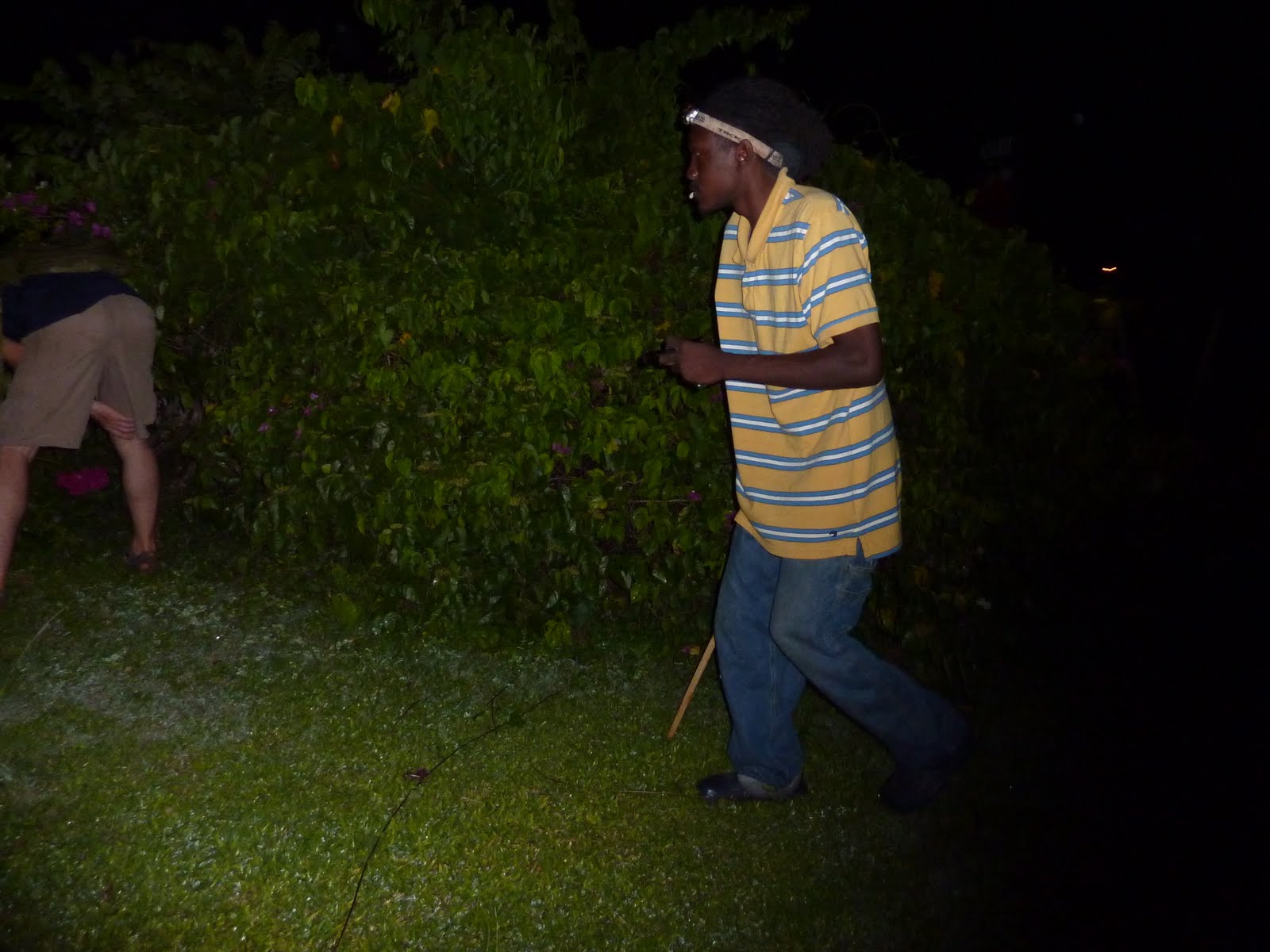
It poured on Saturday night. Soooo...Sunday night was crab night! I called a fellow PCV, Bart to see if he wanted to come crab hunting. Apparently I had done my research well because his landlord Bigga and some other neighbors already had plans to look for crabs in the hills. I was welcome to tag along. We were dropped off by Patrick, a local taxi driver on a random residential street where Bigga had seen crabs before. We turned on our torches (or flashlights) and started sweeping the bushes for beady little land crab eyes. The suspense was quickly lost as we didn't see a singal crab on that street. "It's close to the end of the season" Bigga lamented. We had more luck on the golf course although the two crabs I managed to catch were "wash bawn" meaning they were female and pregnant. The crabs carry their eggs on the outside. Pregnant crabs act strangely. They either don't move at all or they go far from their holes very fast. They are often the ones that get run over by cars as they try to cross the street. They are also the easiest to catch. I was plesantly surprised that my crabbing companions didn't keep the wash bun crabs. Most people I've talked seem to focus more on the immediate rewards (one more fish in my pot) instead of preservation for the future (leave the fish to grow and reproduce).

A "wash bawn" (pregnant) landcrab

Bigga and his friend Bobby seemed to have super human senses. They knew exactly where the crabs were and what they were thinking. They did most of the catching and in the end they had a bag full of about a dozen crabs. Beach road, I thought, tomorrow I'm trying my luck on beach road. I had watched the experts: step on the front of the crab so he can't get you, grab it by the back, then drop it in the bag.

It rained again on Monday afternoon and cleared up just before I left the office. Another perfect land crab night. Bart came over and we armed ourselves with his head lamp and a purple bucket with lid to carry the crabs. I changed into sneakers and we left the house just after dark.

As usual, we got a lot of attention as white people walking down the street. Especially white people walking with a purple bucket and headlamp. "What are you looking for, a taxi?" "No sir!" "Oh, you're looking for crabs" Our new machete-weilding friend in a white t-shirt full of holes made his way towards us. "Lend me your light" he said as he grabbed the head lamp from my hand. I feebly held onto the elastic "No man, we naa need yuh help. We want fi catch crabs ourselves." But my protests were to no avail. He had the light and was on a mission, stabbing crab holes (and sometimes crabs) with his machete. He wouldn't give back the light, so my only option was to follow and grab the crabs after he trapped them with his machete. The rain had brought the crabs out, and after only a few minutes, we had a full bucket. As we said goodbye, the man asked for J$200 as a "tip" for his help. "We never even wanted your help - you took our light!" We didn't have any money, so he insisted we give him the crabs because we "never would have caught them without him." He continued down the road swinging his bucket of crabs cursing loudly to himself "raas, bomba clot, $200"

Back to square one! With a slightly bitter feeling, and realizing we had just scared most of the crabs back into their holes, we set out looking again. Every few feet we were approached by people giving us recipes, wanting to help catch them, and asking lots of questions. Who are we? Where do we come from? Why are we doing something so "local?" We managed to catch two crabs, despite all the attention, and turned back towards home. "I want to catch one more crab on the way back." I said.

Bart looking for crabs

We made friends with Minot who runs a Ital tea stand on the side of the road when he witnessed a crab grab my toe! Luckily Bart could pry it off but I was very glad I wore sneakers! Minot gave me some aloe to soothe my mosquito bites I had inevitably collected by walking through the brush in shorts. He had us try an herbal remedy he made to cure stomach aches and gave me a couple types of grasses to make tea with at home. His generosity and good natured spirit more than made up for our other encounter.

We reached the beginning of beach road, but the only crabs we saw were wash bawn. Through the trees I saw the sweep of flashlights. "How many yuh catch?" I shouted. The proud crabbers opened their bags to reveal about 8 BIG crabs. "Do you want one?" They fished out the biggest one and dropped him into our bucket. "Good luck!" I was satisfied: I had found my third crab on the way home after all.

A whole bag of crab!

That night I hardly slept at all. I kept waking up thinking that the crabs had knocked the bucket over and were running loose in my apartment. Around 2 in the morning they starting scratching around at the bucket. After an hour or so I got so frustrated I put them outside. Who cares if Lucky finds them: I need to sleep. I woke again at 5AM to Lucky barking. Oh no! The crabs! I run outside to see Sandy's face pressed against her screen. The bucket is still standing but Lucky has discovered it. He sniffs at the bucket, but when the crabs start to move he runs away barking. When he almost knocks the bucket over I decide they need to come back inside.

I told the women at the soup kitchen my crabbing adventure and asked them how to cook the crab. Most people either boil them with salt and scotch bonnet or they pick out all the meat and curry them. I didn't have any curry powder and I don't like cleaning crabs while I eat them. So, I decided to cook them like my grandmother cooks Maryland blue crabs: clean them, then sautee them with onions, white wine, and lots of old bay. Two problems: 1) There is no old bay in Jamaica and 2) There was no visible way to pry off the backs like there is with Maryland crabs. The first problem was easily fixed by substituting jerk seasoning (while a little sweeter they smell remarkably similar). I fixed the second problem by boiling the crabs first with the salt and pepper like the soup kitchen ladies prescribed. They were fighters: I had to use my machete to get them into the pot.

Land crabs in my pot

As they boiled a greenish brown scum accumulated on the surface of the water. That can't be healthy. I made sure to scrub all the crabs really well after boiling them to get off the dirt that had accumulated over their lives: again something I hadn't encountered with ocean crabs.

Post-boiling the crabbies hang out in my sink

When they were nice and clean, I cooked them so my family would be proud. They tasted good, but the meat wasn't quite as sweet as the crabs back home. Afterwards, I felt vaguely sick to my stomach. I couldn't tell if I was actually sick or if that was just the feeling that comes from catching strange creatures in a strange land and cooking them yourself. Sandy's sons caught crabs when she lived in the Virgin Islands. She said they kept them for about two weeks feeding them cornmeal to clean their system and coconut to sweeten the meat. Next time, I might try that although I don't know if I would want to keep the beasts for two weeks. All in all it was another great adventure.

Nice and clean and ready to eat